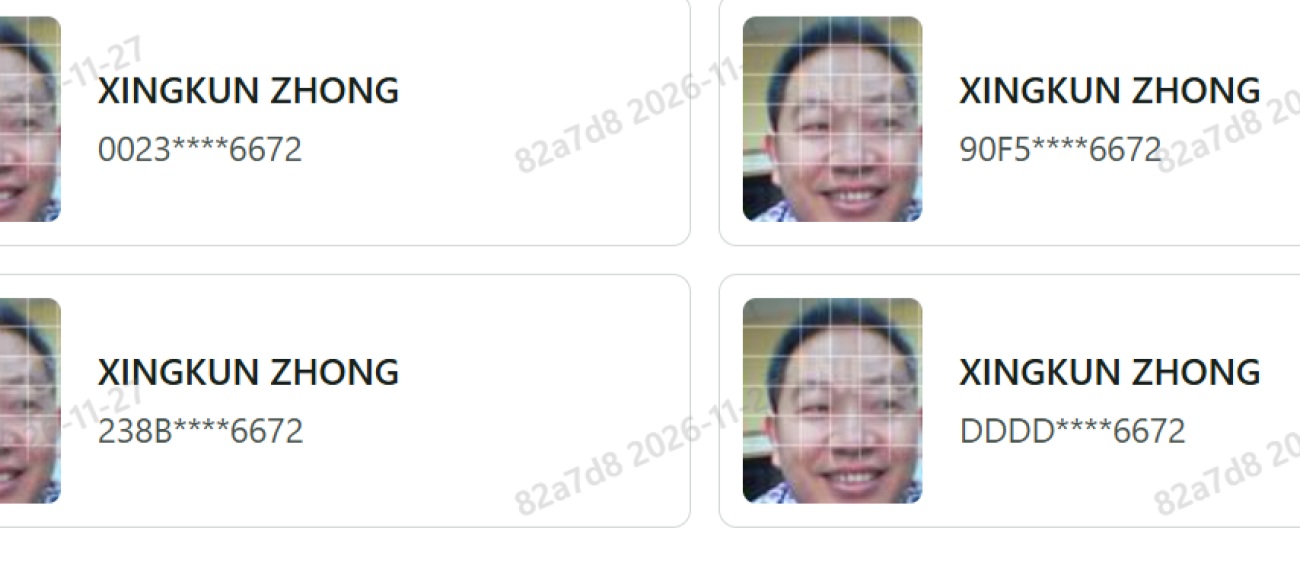
Fresh controversy has erupted over the integrity of Nigeria’s voters’ register after photographs circulating on social media allegedly showed a man with a Chinese name and the same face appearing seven times in the Independent National Electoral Commission’s (INEC) database.
The individual, identified as Xingkun Zhong, reportedly appears seven times under a single polling unit in Abuja, with different voter identification numbers attached to the entries.
Another individual, identified as Thong Frank, was also allegedly listed four times in the same electoral database.
The discovery has triggered fresh questions about how multiple entries could have found their way into INEC’s database and whether the commission’s screening mechanisms are effective enough to prevent electoral fraud ahead of the 2027 general elections.
The photographs have also fuelled concerns about the possibility of unqualified individuals appearing on the country’s voters’ register.
However, the identities and citizenship of the individuals have not been independently established, while the authenticity of the viral screenshots is yet to be officially confirmed.
Under Section 12 of the Electoral Act 2022, only Nigerian citizens who have attained the age of 18 are qualified to register as voters. The law also prohibits multiple voter registration.
The latest controversy comes weeks after INEC announced the removal of 1,608,660 invalid registrations and 873 records belonging to verified deceased persons from its voters’ register.
INEC Chairman, Professor Joash Amupitan, disclosed on November 9 that the commission had identified millions of questionable records through its review of the preliminary register.
The commission initially harvested 11,088,238 registration records from the three phases of its 2025/2026 Continuous Voter Registration exercise.
Its Automated Biometric Identification System (ABIS) flagged 1,545,052 records for further examination before subsequent investigations and complaints led to additional deletions.
Amupitan also disclosed that 54 persons across 10 states had been identified over alleged involvement in registration irregularities and could face disciplinary action, including prosecution.
The development followed another controversy in October when Nigerians examining INEC’s preliminary voters’ register reportedly discovered suspicious photographs, including images suspected to have been generated using artificial intelligence.
INEC subsequently acknowledged the existence of questionable photographs and other irregularities in the database.
The commission’s Director of Information and Communication Technology, Dr Lawrence Bayode, disclosed that 268 records had been flagged for examination over suspected AI-generated photographs and other irregularities.
He also alleged that some registration officials had abused their access credentials to introduce questionable records into the database.
In explaining the irregularities, Amupitan said some of the suspicious names and photographs circulating online were linked to historical voter records captured between 2011 and 2023, rather than exclusively to the latest registration exercise.
The commission subsequently promised to extend its clean-up exercise to cover confirmed duplications in the older database.
With the 2027 elections approaching, the latest allegations involving Xingkun Zhong and Thong Frank have raised fresh questions about whether INEC has fully identified and eliminated questionable entries from its database.
The commission had announced December 15, 2026, as the date for certification of the final Register of Voters after its verification and quality-assurance exercises.
INEC is yet to give a specific public explanation of the latest viral screenshots or establish whether the alleged multiple entries are genuine.
The questions now confronting the commission include how the same individual could allegedly appear seven times under one polling unit and whether its biometric verification system detected the entries.
Don’t Miss Out! Join our WhatsApp Channel for instant news updates. Click here to join