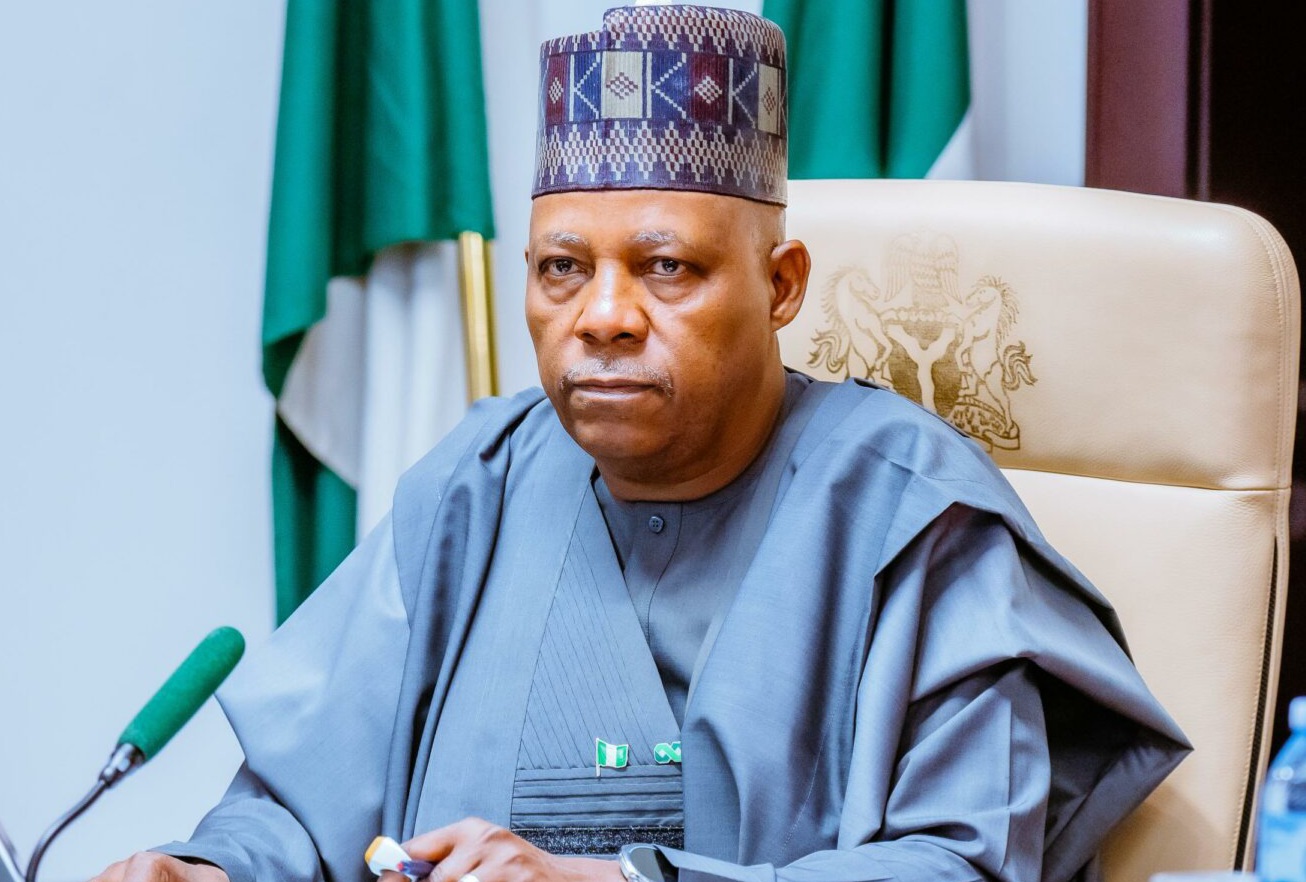
Vice-President Kashim Shettima has explained why he frequently takes on former Vice-President Atiku Abubakar but avoids insulting other opposition figures, including Peter Obi, Oyo State Governor Seyi Makinde and former Kano State Governor Rabiu Kwankwaso.
Shettima said his criticism of Atiku was a form of Fulani political banter, insisting that their shared ethnic background gave him the freedom to exchange verbal attacks with the former presidential candidate.
The Vice-President, however, warned opposition politicians against attacking President Bola Tinubu, declaring that whoever attacked his principal should expect a response from him.
He spoke on Tuesday in Maiduguri, Borno State, during the presidential launch and inauguration of the North-East Development Commission’s multi-sectoral development interventions.
Describing Atiku as an elder statesman whom he holds in high regard, Shettima said their relationship allowed for a different kind of political exchange.
“He’s an elder statesman whom we hold in very high esteem. But as a Fulani man, I have the right to throw stones at him, and he has to endure whatever stones I throw at him,” he said.
He dismissed those who questioned his exchanges with Atiku, describing them as people without an understanding of history.
Shettima also insisted that he had never insulted Obi, Makinde or Kwankwaso, whom he described as personal friends.
According to him, he enjoyed cordial relationships with the opposition politicians and had no intention of turning political differences into personal hostility.
He said, “Peter Obi is my friend. We were governors together. I have never insulted the governor of Oyo State. He is my personal friend. The same goes for the former governor of Kano State, Rabiu Musa Kwankwaso.
“I will not insult him. But whoever attacks our boss, we will attack him too.”
The Vice-President maintained that the ruling All Progressives Congress (APC) would continue to practise politics of tolerance and maturity, provided opposition figures refrained from attacking Tinubu.
He recalled that his disagreement with former President Goodluck Jonathan was partly triggered by his support for former Rivers State Governor Rotimi Amaechi during the contest for the chairmanship of the Nigeria Governors’ Forum.
Shettima said Amaechi was his friend, adding that personal relationships often influenced political alliances.
He also urged Nigerians to support Tinubu’s re-election bid, expressing confidence that the President would secure another term.
Taking a swipe at opposition supporters who rely heavily on social media campaigns, the Vice-President argued that online popularity did not automatically translate into votes.
He said elections were decided at polling units, not on Facebook or Instagram, where supporters could post attractive pictures and campaign messages without necessarily influencing voters.
Meanwhile, Shettima commended the North-East Development Commission for its development interventions, including the provision of 10,000 electric tricycles, 300 electric buses and taxis, and 50-megawatt mini-grids across the region.
He described the promotion of electric mobility as both an environmental necessity and an economic opportunity, noting that the North-East had enormous solar energy potential.
The commission has also reportedly constructed more than 1,000 solar-powered boreholes, alongside roads and bridges.
Shettima identified extreme poverty as a major factor fuelling insecurity in northern Nigeria, linking it to Boko Haram insurgency, armed banditry and ethno-religious crises.
“In Nigeria, poverty wears a northern face. We are in the news for the wrong reasons. Ethno-religious crisis, Boko Haram, armed banditry, and behind all this insanity lies the real cause, which is extreme poverty,” he said.
He praised Borno State Governor Babagana Zulum and other North-East governors for their investments in education, describing education as the greatest driver of social change.
He also commended Gombe State Governor Muhammadu Inuwa Yahaya for his development-oriented leadership.
The Vice-President further defended Tinubu’s economic policies, arguing that the President inherited a difficult economic situation from the previous administration.
He said Tinubu had refused to blame or insult his predecessor, late President Muhammadu Buhari, despite the challenges he inherited.
According to Shettima, the President believes that anyone who inherits an administration must accept both its assets and liabilities, adding that insulting Buhari is one of the quickest ways to incur Tinubu’s displeasure.
Don’t Miss Out! Join our WhatsApp Channel for instant news updates. Click here to join