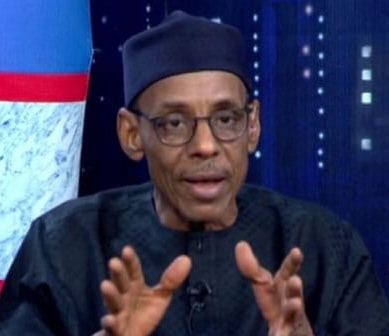
Former Special Adviser to President Bola Tinubu on Political Matters, Hakeem Baba-Ahmed, has revealed why he resigned from the administration, accusing the President of showing little commitment to governance.
Baba-Ahmed, who is now the National Chairman of the People’s Redemption Party (PRP), said he walked away from the government barely 12 to 18 months after it took office because he had become convinced that the administration was heading in the wrong direction.
He made the revelation while speaking in an interview with ARISE NEWS on Friday, where he also predicted that Tinubu would win no more than two states in the 2027 presidential election if the exercise is free and fair.
Explaining why he left the administration, Baba-Ahmed said he saw no convincing signs that Tinubu was serious about addressing Nigeria’s problems.
“I left the administration because I saw no evidence that President Tinubu’s administration was serious about governance,” he said.
He added that the government’s emphasis on presenting economic statistics and figures did not match the worsening hardship Nigerians were experiencing.
Baba-Ahmed argued that rather than fixing the country’s problems, the administration appeared more concerned about retaining political power.
He said the situation had become worse under Tinubu, despite the difficult economic and security conditions inherited from former President Muhammadu Buhari.
“President Buhari handed over to Tinubu a country in a mess. And President Tinubu took it and made it considerably worse,” he said.
The former presidential aide maintained that Nigerians were increasingly frustrated by rising living costs, insecurity and the inability of many families to afford basic necessities.
He cited worsening banditry in parts of the North, saying some communities remained vulnerable to attacks while families struggled to pay school fees, access healthcare and feed themselves.
Baba-Ahmed said the growing anger against the administration would reflect in the 2027 election, insisting that Tinubu would suffer a major electoral defeat if the process was credible.
“If the elections are free and fair, President Tinubu, I repeat, will not win this election. Nigerians as a whole, not just Northwest, will reject him because he has not performed anywhere near what they expected,” he said.
He further declared that the President might not secure more than two states nationwide.
“I said if the elections are credible, free and fair in 2027, President Tinubu is unlikely to win more than two states. I didn’t even say anything about the Northwest. I said in the country,” he added.
The PRP chairman said his prediction was based on his party’s direct engagement with ordinary Nigerians and their growing dissatisfaction with the government.
He insisted that the opposition did not need to distribute money to understand the mood of the electorate, claiming that its interactions with citizens had exposed widespread frustration.
Baba-Ahmed also expressed confidence that opposition parties could defeat the APC in 2027 if they presented a united and credible alternative.
He disclosed that the PRP had been involved in opposition coalition discussions from the beginning, alongside the Social Democratic Party (SDP), Peoples Democratic Party (PDP), Allied Peoples Movement (APM), African Democratic Congress (ADC) and Nigeria Democratic Congress (NDC).
According to him, the coalition has resolved to work towards removing the APC from power, with more political parties expected to join the arrangement.
He accused the ruling party of shrinking the political space for opposition groups through subtle restrictions on campaigns, including difficulties accessing public spaces and mounting campaign billboards.
Baba-Ahmed also dismissed suggestions that northerners would be hypocritical if they withdrew their support for Tinubu after voting for him in 2023.
He argued that voters had every right to change their political preference based on the President’s performance.
The former presidential aide insisted that the North’s growing dissatisfaction was linked to worsening insecurity and economic hardship, warning that the APC could face widespread rejection in the next general election.