

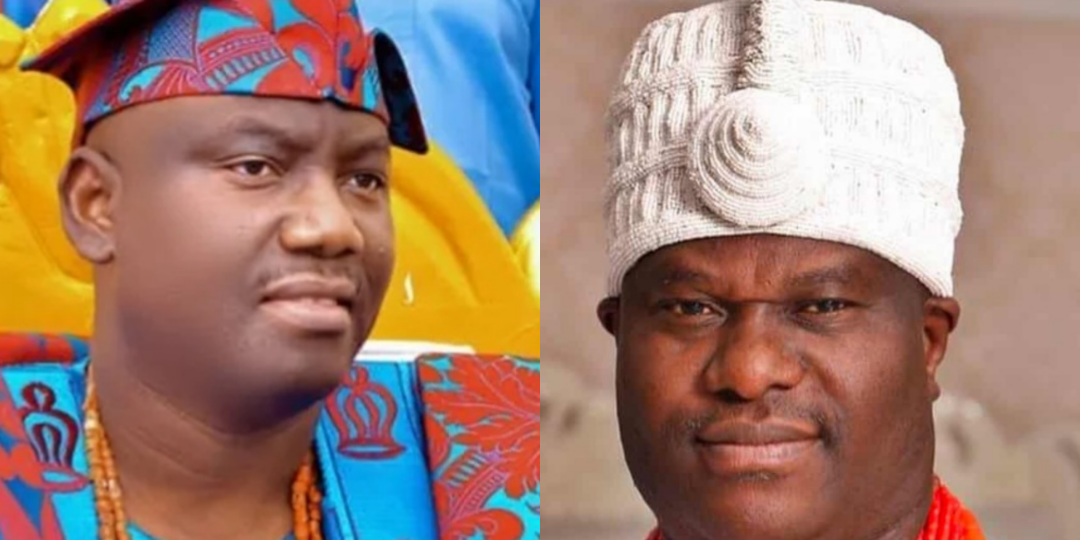
The Alaafin of Oyo, Oba Abimbola Akeem Owoade I, has again brought up the subject of who between him and Ooni of Ife, Oba Adeyeye Ogunwusi, has the authority to confer chieftaincy titles covering Yorubaland on individuals.
There has been no love lost between the two monarchs that stems from supremacy battle bordering on seniority of ranks in Southwest.
Alaafin again announced himself as the only one with the authority to award chieftaincy titles that travers Yorubaland on individuals on Sunday during the installation of Senator Abdul-Aziz Yari as Obaloyin of Yorubaland and President Bola Tinubu’s son, Barrister Seyi Tinubu as Okanlomo of Yorubaland on Sunday at Aganju Forecourt, Aafin Oyo.
This he declared in his speech at the occasion where he remarked that only the throne of Oyo has the authority to confer chieftaincy titles that carry the name “Yorubaland.”
“We are gathered here today for a purpose that goes beyond celebration. We are here to witness history and to place responsibility where tradition has long placed it. Chieftaincy, in our culture is not an act of favour. It is not decoration. It is duty, conferred only when history, authority, and responsibility align.
“From the earliest organisation of the Yoruba people, authority was never vague. Our forebears understood structure. This understanding gave Yorubaland stability long before modern governance arrived.
“The throne of Oyo emerged in that history as a coordinating authority, by responsibility. When colonial administration came, it did not invent this reality; it encountered it and recorded it. By 1914, Oyo Province had become the largest province in Southern Nigeria, covering 14,381 square miles. It was bounded in the north by Ilorin and Kontagora, in the east by Ondo and Ijebu, in the south by Ijebu and Abeokuta, and in the west by French Dahomey. This reflected recognised leadership over a wide and diverse space.
“This history explains why certain chieftaincy titles are different in nature. Titles that bear the name “Yorubaland” are not local titles. They are collective titles. They speak not for one town or one kingdom, but for the Yoruba people as a whole. Such titles must therefore proceed from an authority whose reach, by history and by law, extends across Yorubaland.
“Today, I do not speak to provoke debate. I speak to state order. Among the Yoruba, authority has never been a matter of assumption or convenience. It has always been a matter of history, structure, and law. Thrones were not created equal in function, even though all are sacred in dignity. From the earliest organization of Yorubaland, the Alaafin of Oyo occupied a central and coordinating authority—an authority that extended beyond the walls of Oyo and into the collective political life of the Yoruba people. This was not self-declared. It was recognised, enforced, and sustained across generations.
“Colonial records acknowledged it. Post-independence councils preserved it. Scholars documented it.
“And finally, the Supreme Court of Nigeria affirmed it. The law is clear. History is settled. Chieftaincy titles that bear the name Yorubaland—titles whose meaning, influence, and obligation are not confined to a single town or kingdom—fall under a singular, established authority. That authority is the throne of Oyo,” the monarch stated.