

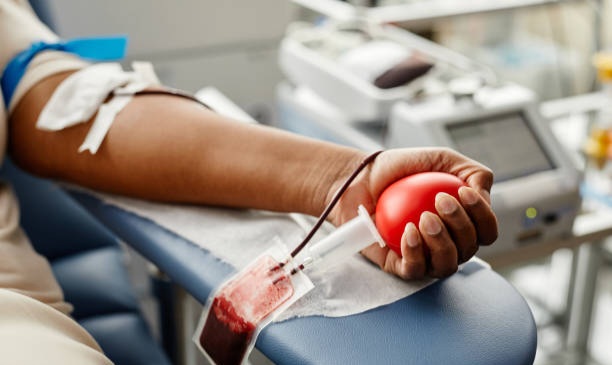
Nigeria’s blood supply situation is becoming increasingly worrying as hospitals battle dwindling donations, soaring processing costs and a shortage of regular voluntary donors.
Health professionals and blood-service operators say economic hardship, inadequate donation facilities, public misconceptions and weak awareness campaigns are making it increasingly difficult to build a reliable pool of voluntary donors.
The situation is particularly troubling because millions of Nigerians depend on blood transfusions every year for emergencies ranging from childbirth complications and road crashes to major surgeries, cancer treatment and sickle cell disease.
Nigeria is estimated to need between 1.8 million and two million units of blood annually, but voluntary donors currently provide only a fraction of that requirement.
Data from the National Blood Service Agency (NBSA) indicates that voluntary, unpaid donors account for only about 10 per cent of blood collected nationwide, with much of the remaining supply coming from family replacement and paid donations.
In Lagos, the situation is similarly concerning. The state collected about 130,000 units in 2025, a decline attributed partly to disruptions caused by the strike by the Joint Health Sector Unions.
Only about eight per cent of blood collected in Lagos comes from voluntary donors, leaving hospitals heavily dependent on replacement and paid donations.
The shortage is being compounded by the rising cost of keeping blood safe for medical use.
The cost of processing a unit of blood in public hospitals has reportedly increased dramatically over the years, climbing from about N3,000 roughly 25 years ago to around N35,000 today.
A source also disclosed that processing charges in some public hospitals have risen from about N15,000 two years ago to N30,000, with an additional N10,000 charged for daycare services.
‘Blood shortage can cost lives’
The Director of Health at the Nigerian Red Cross Society, Dr Aminu Abdullahi, said Nigeria’s culture of voluntary blood donation remained weak despite the fact that some citizens regularly give blood without demanding payment.
He explained that only about one-tenth of the country’s blood supply comes from voluntary, unpaid donors, while family members and paid donors provide most of the remainder.
According to him, the shortage has serious consequences for the healthcare system and could contribute to avoidable deaths, particularly among women experiencing complications during childbirth and victims of accidents.
He also warned that reliance on emergency donations could create additional safety concerns because blood collected under pressure may not always pass through adequate screening processes.

Abdullahi identified poor public awareness, inadequate donation centres and infrastructure, as well as widespread myths surrounding blood donation, as some of the factors discouraging Nigerians from becoming regular donors.
He said the Nigerian Red Cross Society had continued to organise blood drives and awareness campaigns, including activities around World Red Cross Day, but stressed that more sustained efforts were required.
He called for stronger advocacy and public education to make voluntary blood donation a normal part of civic responsibility.
Hunger now affecting donations
Consultant Haematologist at the National Hospital, Dr Ekaete Iniabasi David, said misinformation and fear remained major obstacles to voluntary blood donation.
She explained that some Nigerians were afraid that donating blood could expose hidden health problems or that their blood could be diverted for ritual or other sinister purposes.
David said these misconceptions could be tackled through aggressive public education, adding that younger Nigerians, particularly members of Generations Z and Alpha, could become an important pool of voluntary donors if properly motivated.
But she identified another major obstacle: hunger.
According to her, blood donors are expected to have eaten before donating, making the current economic hardship a serious barrier for people who may not even have enough money for food.
David explained that a potential donor who arrives hungry at a donation centre would normally be advised to eat before giving blood, raising the question of how such a person could afford a meal in the first place.
She disclosed that patients could pay between N15,000 and N20,000 for a unit of blood at some facilities, but clarified that the charges largely cover screening, processing and related services rather than the purchase of blood itself.
David further disclosed that the National Hospital’s blood bank often operates with very low reserves and depends substantially on family replacement donations.
Lagos falls short of target
The Executive Secretary of the Lagos State Blood Transfusion Committee, Dr Bodunrin Osikomaiya, said the state was still far from meeting its blood requirements despite having one of the largest populations in the country.
She said Lagos, with an estimated population of about 20 million, should be collecting between 200,000 and 400,000 units of blood annually.
Instead, the state averages roughly 150,000 units a year and recorded only about 130,000 units in 2025.
Osikomaiya attributed part of last year’s decline to the JOHESU strike, which disrupted hospital activities and consequently affected blood collection.
She explained that blood donation levels are closely connected to hospital activities because increased clinical services usually generate greater demand and opportunities for blood collection.
Despite the available supply, she said hospitals still struggle to meet emergency demands and secure compatible blood for patients with rare blood groups.
Osikomaiya said voluntary donors contribute only about eight per cent of Lagos’ blood supply, while replacement and paid donations account for the bulk.
She added that financial difficulties and inadequate public awareness had contributed to the dependence on paid donations, with some people donating mainly because they need the money.
Nigeria needs up to 2m units yearly
The Director-General of the National Blood Service Agency, Prof. Saleh Yuguda, described blood as an irreplaceable component of modern healthcare.
He said it is essential in treating women suffering obstetric emergencies, accident victims, cancer patients, people undergoing major operations and patients living with sickle cell disease, among others.
Yuguda said Nigeria requires between 1.8 million and two million units of blood every year but continues to fall substantially short of that figure, leaving a deficit of hundreds of thousands of units annually.
He said the challenge was not limited to the volume of blood available but also extended to the safety and quality of collected blood, as not every donation passes through standardised national systems.
The NBSA, he said, was working to improve regulation, quality control, blood banking facilities and the overall management of blood services across the country.
Yuguda acknowledged that awareness had improved in recent years, with increasing participation from young people, companies, religious organisations, universities, the military and development partners.
However, he said the agency’s ultimate goal remained a national blood system based entirely on voluntary, unpaid donations, in line with World Health Organisation recommendations.
He described voluntary donors as the safest donor population and urged healthy Nigerians to embrace regular blood donation as a simple way of helping to save lives.
Yuguda explained that one unit of donated blood can be separated into red blood cells, plasma and platelets, meaning a single donation can potentially benefit as many as three patients.
Own-blood transfusion considered
The NBSA is also considering the wider use of autologous blood transfusion, a system in which a patient donates blood before an elective procedure and later receives his or her own blood.
Yuguda stressed that the approach would only be suitable for carefully selected patients who are medically fit and undergoing planned procedures.
He said the strategy could reduce dependence on donated blood in suitable cases, lower the risk of incompatibility and transfusion reactions, and preserve scarce donor blood for emergencies.
Those who could benefit from the preserved supply include trauma victims, women suffering severe bleeding after childbirth, children with serious anaemia and patients undergoing treatment for cancer or sickle cell disease.
However, he made clear that autologous transfusion was not being proposed as a substitute for voluntary blood donation.
Inflation hits blood processing
The Head of Haematology and Blood Transfusion at the Lagos University Teaching Hospital, Professor Titilope Adeyemo, said voluntary donors had largely remained committed despite the country’s economic difficulties because they understood the importance of helping other patients.
She, however, said inflation had severely increased the cost of running blood services.
According to Adeyemo, blood banks now spend far more on equipment, reagents, consumables, electricity and logistics than they did in the past.
She said the cost of processing a unit of blood had risen from roughly N3,000 when she entered the health system about 25 years ago to approximately N35,000 today.
Private facilities, she added, often charge more because of additional operational and procurement expenses.
Adeyemo stressed that expanding voluntary donation would not only improve the availability of blood but could also help reduce the financial burden associated with securing safe blood for patients.
Power, fuel costs squeeze blood banks
The financial pressure is also being felt by private blood-service providers.
The Chief Executive Officer of Constant Care Blood Bank and Lab, Ikejiofor Nnaemeka, said unstable electricity, expensive fuel and the need for specialised refrigeration systems had increased the cost of running blood banks.
He explained that different blood components must be stored under carefully controlled temperatures to preserve their quality and safety.
Transportation has also become more expensive as fuel prices continue to rise, adding another layer of cost to the blood supply chain.
Nnaemeka warned that unless these pressures are addressed, the increasing cost of operating blood banks could eventually make safe transfusion services even less accessible to Nigerians.
With demand continuing to outstrip supply, health stakeholders say Nigeria must urgently move away from its heavy dependence on emergency, replacement and paid donations and build a stronger culture of regular voluntary blood donation.
Don’t Miss Out! Join our WhatsApp Channel for instant news updates. Click here to join
CIVIL SERVICE SHAKE-UP! NCE CHANGES RULE ON PROFESSIONAL MEMBERSHIP, PROMOTION
‘WHO GAVE CJN THE POWER?’ LAW SOCIETY REJECTS BAN ON ‘BARRISTER’ TITLE