
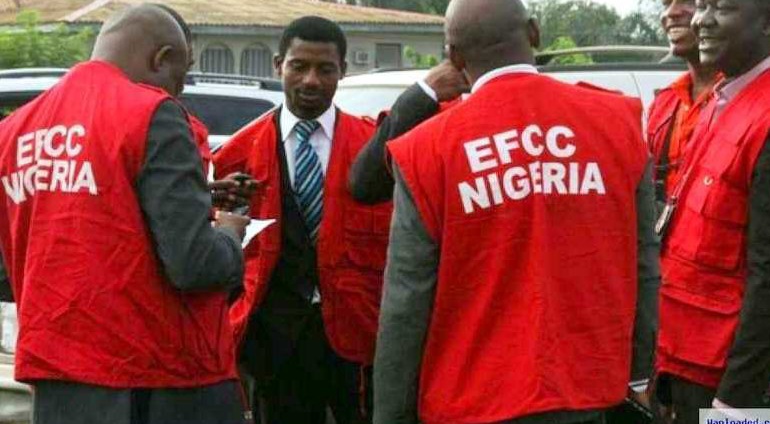
The Economic and Financial Crimes Commission (EFCC) has dropped a bombshell, revealing that 18 states are currently under investigation over alleged mismanagement of public funds.
The commission, however, refused to disclose the identities of the states, saying naming them could jeopardise ongoing investigations.
The disclosure was made by the EFCC Director of Public Affairs, Wilson Uwujaren, during an interview on Arise Television on Thursday while explaining the commission’s controversial restriction of an Osun State Government account.
Uwujaren said the Osun action was not an isolated operation, stressing that the anti-graft agency had either taken or was preparing to take similar steps in other states.
Asked whether other state governments were being investigated, he confirmed that the figure was in the double digits.
He disclosed that about 18 other states had ongoing investigations but declined to name them.
According to him, keeping the identities of the states secret was aimed at protecting the integrity of the investigations rather than shielding any government from scrutiny.
The EFCC spokesman also revealed that the commission had previously restricted an Edo State Government account after allegedly detecting suspicious movement of funds before Governor Monday Okpebholo assumed office.
Uwujaren claimed that the intervention helped preserve about $12 billion for the state, arguing that the resources subsequently became available to the administration that took over.
He insisted that the EFCC’s actions were not politically motivated or targeted at any particular governor or administration.
The commission, he said, was simply exercising its powers under the law whenever its investigations raised concerns about suspicious financial activities.
Explaining why the EFCC did not take similar action during the Ekiti State governorship election, Uwujaren said the circumstances were different, adding that the commission acted based on intelligence that was not available to the public.
OSUN ACCOUNT ROW
On the Osun controversy, Uwujaren clarified that the EFCC had not frozen all the state government’s accounts.
He said only one statutory account had been temporarily restricted, while the state remained free to operate its other accounts.

The EFCC official further disclosed that the commission had 72 hours within which to obtain a court order to sustain the restriction or lift it.
He said the period had not yet expired.
His comments came after the Osun State Government announced plans to challenge the EFCC’s action in court.
Uwujaren said the state was within its rights to seek judicial intervention, adding that the commission would take whatever legal steps it considered necessary.
WHY EFCC BLOCKED ACCOUNT
Defending the legality of the restriction, Uwujaren cited Section 34 of the EFCC Act and Section 7(6) of the Money Laundering (Prohibition) Act 2022, saying the provisions empower the commission to temporarily restrict accounts suspected of being involved in suspicious activities.
He stressed that the powers were not limited to government accounts and could be applied to any account where the commission had reasonable grounds for suspicion.
PROBE STARTED IN MARCH
Uwujaren also disclosed that the investigation into Osun State did not begin with the recent account restriction.
According to him, the probe started as far back as March, with several state government officials already questioned by EFCC investigators.
He therefore dismissed any suggestion that the investigation was suddenly launched because of the approaching governorship election.
The revelation that 18 states are currently facing EFCC investigations is expected to trigger fresh concerns over the management of public funds by state governments across the country.
It also comes amid growing controversy over the commission’s action against the Osun Government account, which has drawn strong objections from the state government and the Nigerian Bar Association.
Don’t Miss Out! Join our WhatsApp Channel for instant news updates. Click here to join
Detained ‘DG’ Rejects Closed-Door Interrogation, Demands Live Hearing