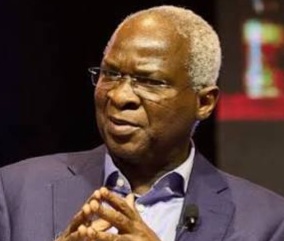
Former Lagos State Governor, Babatunde Fashola, has sparked fresh debate over Nigeria’s economic hardship after linking the rising cost of living to global conflicts, insisting that even ordinary market traders are feeling the impact of international developments.
Fashola, while defending President Bola Tinubu’s economic policies, argued that Nigeria’s inflationary pressures could not be viewed in isolation from disruptions to global supply chains caused by the COVID-19 pandemic, the Russia-Ukraine war and conflicts in the Middle East.
The former Minister of Works made the remarks on Tuesday during an appearance on Channels Television’s Politics Today.
Explaining how international developments affect prices in Nigerian markets, Fashola said traders now considered the cost of replacing their goods when fixing prices.
“Even the tomato seller knows the Strait of Hormuz and prices his or her goods according to replacement costs now,” he said.
The comment has become a talking point in coverage of his interview, although there are yet to be substantial, independently verified public reactions from prominent Nigerians directly addressing the remark.
Fashola maintained that the cost-of-living crisis was a global challenge and that Nigeria could not escape its consequences.
He explained that the pandemic disrupted production and international supply chains, while the Russia-Ukraine war affected supplies of essential commodities, including food and energy products.
He also cited tensions in the Middle East, particularly their implications for international energy markets and shipping costs.
However, the former governor’s explanation comes amid continuing concerns over the impact of domestic economic policies on Nigerian households.
Tinubu’s removal of petrol subsidy and the devaluation of the naira have been identified among the major domestic factors behind rising prices, alongside higher business and transportation costs.
A Congressional Research Service assessment of Nigeria’s economy also identified the subsidy removal and exchange-rate unification as factors that contributed to the increase in the cost of living.
Fashola, however, insisted that the Tinubu administration had introduced measures to cushion the effects of the economic difficulties.
He listed the minimum wage review, the Nigerian Education Loan Fund, NELFUND, tax reforms and the introduction of compressed natural gas as some of the government’s interventions.
He acknowledged that the measures had yet to provide sufficient relief but argued that their implementation was progressing.
“I’m not saying it is enough. There are initiatives like the introduction of CNG, but there’s a distance between policy, between programme, between projects and resources,” he said.
Fashola expressed confidence that Nigerians would begin to experience the benefits of the government’s interventions as their implementation progressed.
His comments also formed part of a wider defence of Tinubu’s administration ahead of the 2027 general elections, with the former governor challenging opposition parties to present convincing alternatives to the government’s economic reform programme.
Don’t Miss Out! Join our WhatsApp Channel for instant news updates. Click here to join