

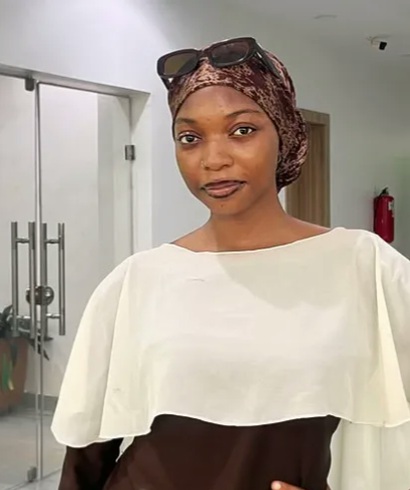
A Nigerian woman born without conventional fingerprints has opened up about the bizarre and frustrating battles she has faced with biometric systems, revealing how a routine JAMB registration once left her in tears.
The woman, who identifies herself on Instagram as J for Jidds (@jidds.xo), said her condition became obvious to her in 2017 when she attempted to register for the Joint Admissions and Matriculation Board examination.
Instead of a smooth registration, she said she spent virtually the entire day at the centre with her father because the fingerprint scanner could not capture her prints.
According to her, more than 200 candidates completed their registrations while she remained stuck, desperately trying to get the machine to recognise her fingers.
The situation became so frustrating that officials reportedly tried several unconventional methods, including sand, spirit, methylated spirit, chalk and even watermelon, in an attempt to make her fingerprints readable.
At one point, she said she resorted to scrubbing her hand against a stone before she eventually managed to complete the registration.
But getting registered was only the beginning.
She said the same problem followed her into the examination hall, where biometric verification sometimes allowed her to gain entry but failed when she needed to authenticate herself again.
“Sometimes I would be able to thumbprint in and I will not be able to thumbprint out,” she recalled.
The ordeal resurfaced during her National Youth Service Corps programme, where she said she had to rely on her toes because the ridges on her fingers were absent and those on her toes were extremely faint.
Banks and other institutions requiring biometric verification have also become sources of anxiety for her.
“Living in Nigeria without fingerprints has been terrible,” she said, describing the experience as frustrating and stressful.
Her condition, known as adermatoglyphia, is a rare disorder characterised by the absence of the ridge patterns that form fingerprints on the fingers, toes, palms and soles. Medical literature notes that the condition can make conventional fingerprint identification difficult or impossible.
MedlinePlus Genetics says adermatoglyphia is linked in some cases to mutations affecting the SMARCAD1 gene and that the condition is rare, with only a small number of affected families identified worldwide. It has also been dubbed the “immigration delay disease” because people with the condition can encounter problems at borders where fingerprinting is mandatory.
Jidds said her struggle was made worse by misconceptions about the condition.

She recalled being called a “ritualist” by some people who apparently could not understand why she had no visible fingerprints.
Her experience has also prompted other Nigerians with similar conditions to share their own stories.
Some social media users said they had encountered difficulties at embassies, during NYSC and in banks because biometric machines could not properly capture their prints.
One user described her own NYSC experience as a “nightmare”, while another said she had suffered embarrassing encounters with bank customer service representatives.
Jidds also revealed that toe prints have occasionally helped her overcome biometric hurdles, although she said the ridges on her toes are too faint to provide a reliable solution every time.
Her story has now raised questions about whether Nigerian institutions have adequate alternatives for people who cannot use conventional fingerprint biometrics.
Interestingly, a 2025 Nigerian medical education publication documented a case of incomplete adermatoglyphia in which doctors obtained toe and lip prints and prepared official documentation recommending alternative biometric identifiers for use with JAMB and other authorities.
Dermatologist Dr Folakemi Cole-Adeife also advised people who believe they have the condition to seek medical confirmation.
She said affected individuals could visit a consultant dermatologist at a teaching hospital for assessment and, once the condition is confirmed, obtain documentation requesting exemption from fingerprint-based biometric procedures.
Cole-Adeife, a consultant dermatologist at Lagos State University Teaching Hospital, has also been identified publicly as a specialist in dermatology and venereology.
For Jidds, however, the bigger issue goes beyond obtaining exemptions.
She wants institutions that rely heavily on fingerprints to recognise that not everyone has the biological features their machines are designed to read.
“If they have knowledge of this issue, why is it that there’s no provision for people like us?” she asked.
Her unusual experience has now turned into a wider conversation about the need for more inclusive biometric identification systems in Nigeria—systems that can recognise people even when their fingers simply refuse to leave a print.
Don’t Miss Out! Join our WhatsApp Channel for instant news updates. Click here to join
ALSO READ: