
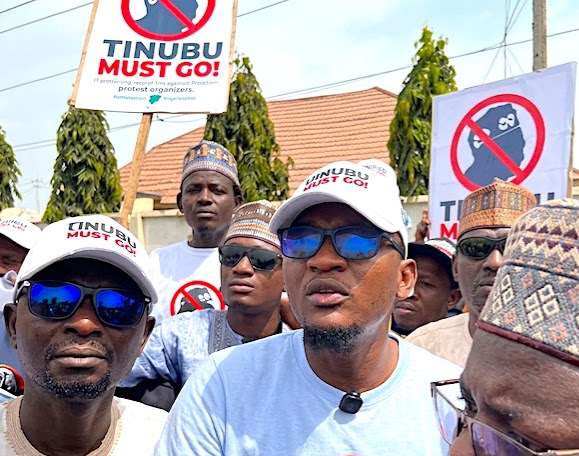
The Kano State Police Command has defended its blockade of a planned meeting by members of the anti-President Bola Tinubu movement, Tinubu Must Go (TMG), insisting that the action was taken to prevent a possible security breach.
The Commissioner of Police, Ibrahim Adamu Bakori, said the police were concerned about the safety of the organisers, their supporters and other residents of Kano, particularly because the gathering was expected to attract about 700 people.
The explanation followed protests by TMG members, who accused the police of preventing them from exercising their constitutional rights by surrounding the venue of their planned meeting on Sunday.
One of the movement’s conveners, lawyer Abba Hikima, had alleged in a Facebook Live broadcast that more than 10 mobile police vehicles were deployed to stop members from accessing the private venue they had paid to use.
Hikima argued that the group did not require police permission to hold its meeting and accused the Inspector-General of Police, Olatunji Rilwan Disu, and Bakori of allowing political considerations to interfere with their duties.
He warned that the movement could resort to protests and street demonstrations if similar restrictions continued.
“Next time, we are going to protest; next time, we are going to demonstrate,” Hikima declared, insisting that the police action had strengthened the group’s resolve to demand Tinubu’s departure from office.
CP: WE DID NOT WANT ANYBODY ATTACKED
However, Bakori, speaking in an interview with DCL Hausa, said the police were not opposed to the group’s right to assemble but needed information about the planned gathering to make adequate security arrangements.
He acknowledged that the law did not require the organisers to obtain police permission or formally notify the Command before holding the meeting. He nevertheless maintained that notifying the police would have helped the authorities assess potential risks and protect those attending.
According to the commissioner, he contacted Hikima after seeing information about the proposed gathering on social media the night before the event.
Bakori said he asked the lawyer to come for discussions about the meeting, including the number of expected participants and the nature of their activities.
He claimed that Hikima promised to consult other members of the movement and get back to him but did not respond to subsequent calls.
The police chief said the Command was particularly concerned because the gathering was expected to draw hundreds of people into Kano without sufficient information about their movements and accommodation arrangements.
“We need to protect them and the residents of the state. That is what happened,” Bakori said, explaining that the police wanted to prevent attacks, disorder and unnecessary tension.

CP RECALLS SABON GARI WEAPONS SEIZURE
In defending the police deployment, Bakori cited an incident in Sabon Gari about two weeks earlier, claiming that officers seized weapons and arrested some people who allegedly said they had come to Kano for political activities.
He said the incident informed the Command’s decision to take precautions over another gathering expected to attract a large crowd.
The commissioner did not establish that members of the TMG movement were connected to the Sabon Gari incident. Rather, he presented the earlier development as part of the security concerns that prompted the police to seek more information about the planned meeting.
Bakori maintained that the authorities needed to understand the nature of an event before making arrangements to secure it, adding that the objective was to protect both the organisers and members of the public.
He also said political groups from different parties had held activities in Kano in the past, with the police providing security for such gatherings.
‘WE ARE NOT WORKING FOR ANY POLITICAL PARTY’
Bakori rejected allegations that the Command’s action was politically motivated, insisting that the police were only carrying out their responsibility to maintain law and order.
He said Hikima had previously brought complaints to his office and that the Command had investigated them and taken action where necessary.
According to him, the police had also provided security for some of the movement’s previous activities, which he said ended peacefully.
The commissioner argued that the dispute could have been resolved through dialogue if the organisers had met with the police to discuss the planned gathering.
However, the blockade has raised questions about the balance between security concerns and the constitutional right to peaceful assembly, particularly where a political movement is openly critical of the President.
THE BIGGER PICTURE
The dispute comes amid political opposition to Tinubu’s administration, with the Tinubu Must Go movement using its name and activities to demand that the President leave office.
The Kano incident highlights a recurring challenge for security agencies: how to prevent violence at politically sensitive gatherings without unlawfully restricting peaceful dissent.
Under Section 40 of Nigeria’s Constitution, citizens are entitled to assemble freely and associate with others, including forming or belonging to political organisations. Section 45 permits certain restrictions on rights under specified conditions, including measures reasonably justifiable in a democratic society for public safety and public order.
The key issue, therefore, is not simply whether the police had security concerns, but whether the measures taken were lawful, necessary and proportionate to any identifiable threat.
Bakori said the Command’s intention was to protect everyone, while Hikima maintained that the police had denied the movement access to a venue it had paid for and interfered with its civic rights.
Don’t Miss Out! Join our WhatsApp Channel for instant news updates. Click here to join