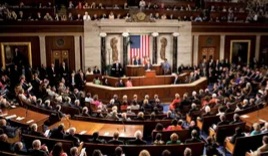
The US House of Representatives has agreed to an amendment bill that would increase withholding of assistance to Nigeria from 50 percent to 100 percent until it takes effective steps to prevent and respond to violence within its territory.
Gregory Stuebe, who represents Florida’s 17th congressional district in the House, proposed the amendment on Wednesday.
Lawmakers later agreed to the move with a voice vote.
The House had first proposed to half funds appropriated for Nigeria in April until the secretary of state certified that the Nigerian government had taken “effective steps to prevent and respond to violence and hold perpetrators accountable.”
Speaking in support of his motion, Steube said withholding only 50 percent of the funds appeared to reward the Nigerian government “despite failure to meet its fundamental obligation to protect citizens.
“I rise in strong support for my amendment to increase the withholding threshold for assistance to Nigeria, from 50 percent to 100 percent. While keeping in place benchmarks that demand Nigeria take effective steps to address the violence and persecution that continue to devastate the country.
“Nigeria has faced a horrific wave of violence that its corrupt government has failed to address.
“For years, and especially in recent months, Christians and other religious minorities in Nigeria have been subjected to violence and terrorism at the hands of extremists operating with impunity.
“Christian women and girls continue to be abducted, assaulted, tortured, and killed. Their churches are burned, and entire communities are erased.
“If the aid conditions included in the bill are important enough to withhold half of all the funding to the Nigerian government, then they are important enough to withhold all of the funding.
“The generosity of our taxpayers is a reflection of the American values we hold so firmly.
Never should we allow their hard earned tax dollars to be funnelled to corrupt regimes that fail to uphold religious freedom, fail to adequately confront terrorism, and fail to protect the innocent from persecution.
“So, why are we rewarding a government that fails to meet such a basic obligation?”
Steube said it is absurd to expend foreign aid to Nigeria in the face of rising insecurity, especially as America’s national debt approaches $40 trillion.
He said his amendment proposal would ensure that US aid is appropriately leveraged to defend, reflect, and uphold American values.
In 2025, US President Donald Trump redesignated Nigeria a country of particular concern (CPC) over Christian genocide claims, before following up with a missile strike on Nigerian territory on Christmas Day.
Nigeria and the United States have since entered a military partnership targeting terrorists in the country’s arid and vast northern region.
Meanwhile, the British High Commission has reaffirmed its commitment to supporting Nigeria’s legislative frameworks to ensure funding, transparency and respect for human rights in the country’s security sector.
The commission’s Head of Development Cooperation, Ms Cynthia Rowe, stated this at a roundtable on national security at the ongoing 2026 National Assembly Open Week in Abuja.
Rowe said that the UK Government, through its Strengthening Peace and Resilience in Nigeria (SPRiNG) programme, welcomed the initiative.
According to her, sustainable security requires strong and accountable institutions that are responsive to the needs of the people.
“The UK Government remains committed to supporting Nigeria’s legislative frameworks to ensure that security interventions are transparent, well-resourced and firmly rooted in respect for human rights,” she said.
Rowe commended the roundtable, describing it as a step toward codifying reforms that would protect vulnerable communities and foster long-term stability.
She said that the roundtable’s discussion areas perfectly aligned with the SPRiNG programme’s security sector reform objectives.
Rowe said that it addressed pressing issues such as banditry, kidnapping and farmer-herder conflicts.
She added that it also explored critical need for inter-agency collaboration, technology and innovation in security operations and 21st-century community engagement.
In his remarks, the Team Leader of the SPRiNG programme, Mr Ukoha Ukiwo, underscored the importance of a legislative framework in ensuring transparency.
Ukiwo said that programmes’ interventions across states continually highlighted that operational peace-building must be backed by robust legal frameworks.
“The focus of this roundtable on state policing, security funding and accountability is incredibly timely.
“By bridging the gap between grassroots realities and legislative action, we can ensure that informal and formal security architectures work cohesively to build formidable resilience in communities across Nigeria.”
Ukiwo said that the SPRiNG programme stood ready to support follow-up engagements with relevant stakeholders to ensure that the resolutions from the dialogue were actively implemented.