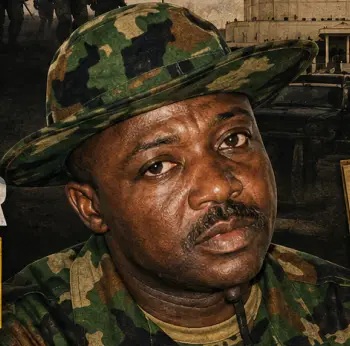
Colonel Mohammed Ma’aji, accused of being part of an alleged plot to overthrow President Bola Tinubu’s government, has revealed why he and his associates allegedly contemplated taking action against the administration.
Ma’aji claimed that Nigeria had deteriorated so badly that he feared the country was heading towards collapse, insisting that his alleged involvement was motivated by patriotism and concern for the nation rather than a personal ambition to seize power.
The colonel said economic hardship, poor governance and worsening conditions for Nigerians and soldiers had fuelled his frustration and pushed him towards the alleged plot.
Speaking on the development, Ma’aji said he had become increasingly disturbed by the direction of the country, describing Nigeria as being on a dangerous trajectory.
He reportedly made the remarks in an interview published by Premium Times on Monday.
Ma’aji said his concerns were also personal, revealing that he struggled to provide for his five children on his military salary.
He reportedly questioned how ordinary military families could afford quality education for their children amid the worsening economic situation.
The colonel also raised concerns over the welfare of soldiers, particularly those wounded during military operations.
He alleged that some injured soldiers receiving treatment at the 44 Nigerian Army Reference Hospital in Kaduna were not getting adequate care.
According to him, the plight of civilians and military personnel convinced him that drastic changes were needed.
Ma’aji further claimed that Nigeria was gradually becoming a “banana republic” and compared the current situation with the military era, which he believed functioned better in some respects.
But despite the seriousness of the alleged plot, Ma’aji disclosed that it had not reached the execution stage before his arrest.
He said the group was still trying to mobilise officers who shared their concerns and had not yet formed a complete team.
According to him, there was no fixed date for the proposed operation because the group was still waiting for additional officers, soldiers and resources.
He said the plan was to recruit enough like-minded military personnel before taking any further step.
Ma’aji also claimed that he personally financed much of the alleged plan, while Timipre Sylva allegedly contributed about N400 million.
He denied any foreign involvement and insisted that no date had been fixed for the operation.
The colonel also denied contacting some senior military officers, but said dissatisfaction within the military and his unsuccessful promotion attempts contributed to the revival of the alleged movement.
He called for the creation of a formal avenue through which military personnel could raise grievances with the Chief of Army Staff, Waidi Shaibu, without fear of victimisation.
Among his recommendations were improved salaries and welfare packages for soldiers, better pensions, increased access to education and tougher action against corruption in government and the armed forces.
Ma’aji also criticised the removal of fuel subsidy, arguing that the policy should have been introduced gradually to reduce the impact on Nigerians.
Following his arrest, however, the colonel made a dramatic appeal for forgiveness and leniency.
He said his experience in detention had changed his thinking and that, if released and the same problems persisted, he might consider a different approach.
Ma’aji pleaded with the authorities to treat him and the others as first offenders and give them an opportunity to “mend our ways.”
He maintained that the alleged plan was never intended to destabilise Nigeria, insisting that it was driven by what he described as love for the country and the desire to see it become prosperous.
The alleged coup plot was uncovered in September 2025, triggering major security concerns and resulting in the cancellation of the October 1 Independence Day parade.
The development also led to changes in the military hierarchy, including the removal of Christopher Musa as Chief of Army Staff at the time.
Ma’aji’s latest account has now provided a glimpse into the thinking he claims was behind the alleged plot, portraying it as an uncompleted mobilisation effort fuelled by deep dissatisfaction over the state of the country and the welfare of military personnel.
Don’t Miss Out! Join our WhatsApp Channel for instant news updates. Click here to join
ALSO READ: