

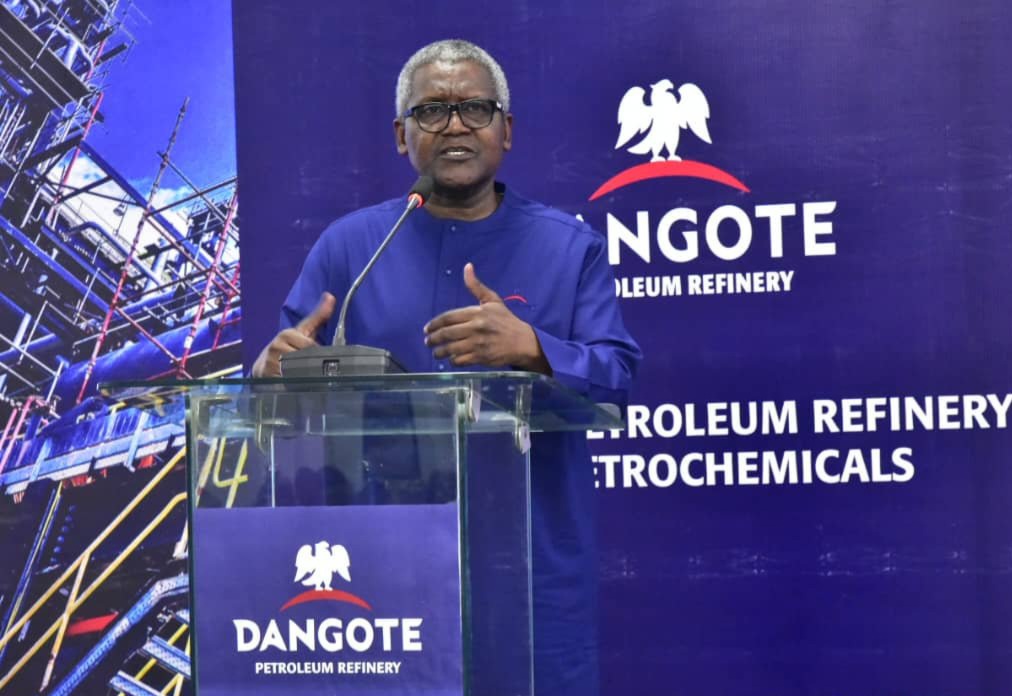
David Precious, Senior Market Analyst at EBC Financial Group, has warned that Dangote Petroleum Refinery’s reported $40 billion private-placement valuation could trigger a major transformation of Nigeria’s stock market if the giant refinery eventually lists on the Nigerian Exchange (NGX).
The analyst said the proposed listing could turn the refinery into one of the most powerful companies on the Nigerian capital market, potentially accounting for about one-quarter of the entire value of companies listed on the NGX.
Using the Central Bank of Nigeria’s foreign exchange rate of N1,365.6856 per dollar on August 7, the $40 billion valuation translates to about N54.63 trillion.
With the NGX’s total market capitalisation currently standing at N158.513 trillion, the addition of Dangote Refinery at that valuation could push the market’s total worth to about N213.14 trillion.
That would mean Dangote Refinery alone could command about 25.6 per cent of Nigeria’s entire stock market value.
But experts warned that the refinery’s true influence would depend on how many shares are released to the public and how easily investors can trade them.
$40BN PRICE TAG UNDER INVESTOR SPOTLIGHT
David Precious said the massive valuation could become a defining moment for Nigeria’s equities market, but investors would need convincing evidence that the figure is justified.
“If Dangote Refinery entered the Nigerian Exchange at close to a USD40 billion valuation, it could account for roughly one-quarter of the resulting NGX market value,” he said.
He added that the impact could spread across the entire market if the valuation becomes difficult to sustain, if only a small number of shares are available for public trading, or if investors sell existing holdings to raise money for the IPO.
The analyst stressed that the final outcome would depend on key details such as the company’s financial performance, debt position, cash flow strength, investment plans and the number of shares made available to Nigerians and foreign investors.
PRIVATE DEAL DOES NOT GUARANTEE IPO PRICE
The reported $40 billion valuation was based on a private transaction and does not automatically represent the final price investors will accept when the refinery goes public.
Details released on August 4 showed that a $2.5 billion private placement for a six per cent stake implied a valuation of about $40 billion.
The planned initial public offering (IPO) is expected to target about $5 billion, although the final valuation and percentage of shares to be offered publicly have not been disclosed.

Market watchers said private transactions can sometimes produce valuations different from what a wider pool of public investors is willing to pay.
DANGOTE’S VALUATION TOWERS OVER GLOBAL RIVALS
The refinery’s reported valuation has also drawn attention when compared with other major energy companies.
Public market figures cited alongside the transaction placed Türkiye’s Tupras at about $12 billion and US-listed HF Sinclair at about $16 billion.
Dangote Refinery’s implied $40 billion valuation is roughly 3.3 times higher than Tupras and 2.5 times higher than HF Sinclair.
However, analysts cautioned that the comparison is not direct because the companies differ in profitability, debt levels, operations and future growth prospects.
Still, the valuation gap has increased pressure on Dangote Refinery to provide strong financial evidence to justify the price tag.
$5BN IPO COULD TRIGGER MARKET BATTLE
The planned $5 billion fundraising is estimated at about N6.83 trillion based on the August 7 exchange rate.
That amount represents about 4.3 per cent of the current NGX market value.
If the funds come from new local and international investors, analysts believe the IPO could inject fresh capital into Nigeria’s equity market.
However, if investors raise money by selling existing shares, other listed companies could suffer as funds move from current holdings into Dangote Refinery.
The big question facing the market is whether the IPO will attract new money or simply redistribute existing investment.
TRILLION-NAIRA COMPANY, BUT HOW MANY SHARES WILL TRADE?
Analysts said Dangote Refinery’s overall valuation alone will not determine its impact on daily market activities.
NGX rules show that companies can qualify for listing based on public ownership requirements or the value of publicly tradable shares.
However, shares controlled by promoters, directors, government entities or strategic investors are excluded from public ownership calculations.
This means a company worth tens of trillions of naira could still have limited shares available for ordinary investors if ownership remains concentrated.
The key issue will be how much of Dangote Refinery becomes accessible to the investing public.
AFRICAN INVESTORS EYE BIG OPPORTUNITY
The refinery’s IPO has also attracted attention beyond Nigeria.
Reports indicated possible interest from investors in South Africa, Kenya, Egypt, Ghana and Rwanda.
Kenyan participation of up to $500 million was mentioned, although no final allocation has been confirmed.
The Johannesburg Stock Exchange has also disclosed that Dangote Group showed strong interest in pursuing a South African listing after Nigeria.
Analysts said regional participation could bring additional foreign capital into Nigerian equities, while a later South African listing could expand access to investors without increasing the money raised through the Nigerian IPO.
PENSION FUNDS FACE MAJOR DECISION
Nigeria’s pension industry is also expected to play a major role in the IPO conversation.
The National Pension Commission (PenCom) granted a special waiver allowing Pension Fund Administrators to consider investing in the proposed Dangote Refinery IPO despite normal requirements relating to company history, profitability and dividend records.
However, pension managers must still comply with internal investment rules, risk controls and their responsibility to contributors and retirees.
Pension funds held about N5.907 trillion in domestic ordinary shares at the end of June, compared with the estimated N6.83 trillion equivalent size of the proposed IPO.
Experts said the figures highlight the scale of the decision facing fund managers but do not mean pension funds will finance the entire offer.
SEC HOLDS FINAL CARD
The Securities and Exchange Commission (SEC) remains central to the refinery’s market debut.
The commission had earlier stated on June 23 that no IPO application had been filed or approved at that time and warned against unauthorised promotion of the offer.
However, later reports indicated that an IPO application had been submitted, with regulatory approval expected in the coming weeks.
Before investors make final decisions, the approved prospectus is expected to reveal the company’s valuation, number of shares offered, ownership structure and how the funds raised will be used.
Precious said the listing could become a historic milestone for Nigeria’s capital market if it brings wider public ownership and attracts fresh African investment.
“Investors still need clear evidence supporting the valuation, clarity on how much of the company they can trade and an explanation of where the money raised will go,” he said.
The Dangote Refinery IPO is now shaping up as one of Nigeria’s biggest market tests — a deal that could either open a new era for the country’s capital market or raise concerns about one company becoming too dominant on the exchange.
Don’t Miss Out! Join our WhatsApp Channel for instant news updates. Click here to join
ALSO READ: