

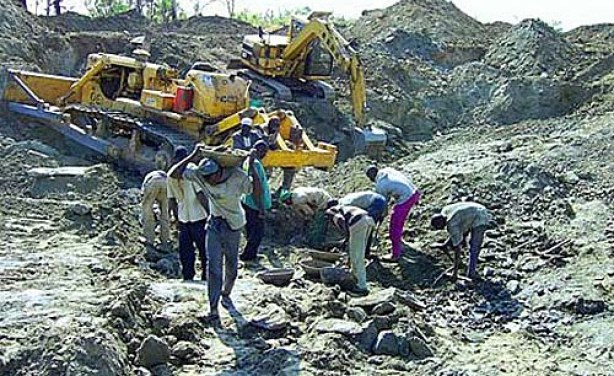
The Federal Government has offered tax holidays and duty waivers on imported mining equipment to foreign investors in the nation’s mining industry.
Read also: Tax holiday, effective taxation and high productivity By Jide Ayobolu
The Minister of Mines and Steel Development, Dr. Kayode Fayemi, conveyed the offer while speaking on ‘Mining for Shared Prosperity: Why Nigeria, Why Now?’ at the opening session of the Africa Down Under Conference in Perth, Australia recently, according to a statement made available to our correspondent in Abuja.
Fayemi listed incentives available to investors in the mining sector to include renewable tax holidays, duty waivers on imported mining equipment, and 100 ownership of business concerns, among others.
The minster, who spoke to a gathering of African Ministers of Mines and Minerals, policymakers, investors, operators and mining financiers at the conference, said the massive deposit of nickel in Dagoma, Kaduna State, was a game changer for the Nigerian economy.
He told potential investors that although it was the responsibility of the Federal Government to issue them operating licences, they needed to work with state governments and host communities to secure stakeholders’ support needed to succeed in the mining sector.
Fayemi stated, “You need the cooperation of the host communities as well as the state governments. Even when our constitution allows the Federal Government to issue you licences, you need the understanding and cooperation of the state governments and the host communities in whose environment you are going to work.
“The host communities should have a stake in your investment. Once that is done, they will see themselves as part owners and will ensure that no one sabotages your efforts. This, we have learnt through experience.”
Speaking on the nickel deposit reputed to be of a high grade and covering about 20 square kilometres in Dagoma village, Southern Kaduna, the minister said the security of the environment was one of the first major steps taken by the government to ensure the success of the project. He added that the government was collaborating with Comet Minerals Limited, the company that discovered the mineral, on sundry aspects of the project.
The minister noted that the nickel discovery could be a game changer if properly managed, adding that the government would support it all through in line with the wealth and job creation agenda of its diversification plan.
Recalled that, the Federal Government recently reiterated its determination to improve her engagement with State Governments and stakeholders in the minerals and mining sector to achieve full potentials of the industry for wealth creation and employment. Minister of Mines and Steel Development, Dr Kayode Fayemi, who made this known in a statement by his Special Assistant on Media, Olayinka Oyebode, who said there was need to partner with states, particularly around financial participation, revenue sharing and recognizing the oversight on the part of Federal Government.
According to him, “the new roadmap for the sector already dwells on this and States are being taken into consideration- ranging from the establishment of the Council on Mining and Mineral Resources Development to the extension of derivation principle of 13% to mineral resources extraction at the state level”.
He noted that in line with the initiative, the ministry commenced a nationwide tour of mining sites and meeting with stakeholders starting with Kaduna, Lagos and Ogun States.
The minister said that the essence of the tour was to ensure that all parties recognize their social responsibilities.
“The Ministry is working to attract a diverse portfolio of participants from artisanal miners to junior explorers to mining majors into the industry”, Dr Fayemi added.

Earlier, the President of the Nigerian Mining and Geosciences Society, Professor Olugbenga Okunlola, noted that the society in its 56th year of existence has assisted the government and the private sector in policy formulation and execution, intellectual contribution in the sphere of mining, oil and gas, water and mineral processing, training and skills acquisition engagement.
He said that the society has also organized programs, lectures, workshops, short training, direct and indirect engagement in the extractive industry, adding that the extractive industry produce the wealth of the nation.
It is a known fact across the globe that the speed of development depends on the resource mobilization especially, finance. For a country to attain growth and the development of the economy has to be diversified, that is, there should be simultaneous development of the various sectors instead of practicing mono-culturalism.
The expansion of export base is of tremendous importance to the overall development of the economy. Initially, for oil export country like that of Nigeria, the problem according to our government was how to spend the revenue accruing to country not the generation of the revenue. Subsequently the credit worthiness of the country exposed her to acquisition of loans abroad following this, was the glut in the international oil market, brought about distortions in production and consumption, which gave a false twist to the Nigeria economy.
There is no doubt that petroleum has contributed substantially to the export revenue in Nigeria and other non-oil exporting countries especially when prices were on the upward trend. Experiences over the years indicate. However, that supply as well as demand limitations make the continuation of large earnings from the petroleum unlikely. There is therefore, the need for strategies and policies for the diversification of the Nigeria revenue base. The non-oil export comprises mainly, solid mineral development, agricultural product minerals and manufactures.
The Nigeria non-oil export since independence has been dominated by primary agricultural and unprocessed minerals products.
Furthermore, it is important to note that, States with active mining of solid minerals in their domains are to receive 13 per cent derivation revenue, just as their counterparts in oil and gas producing areas, the federal government has said. The Minister of Mines and Steel Development, Kayode Fayemi, who said this in Abeokuta, Ogun State, said serious-minded operators in the mining sector would soon be granted access by the government to the intervention finance for mining from the National Resource Fund. The minister, who was addressing the opening of the National Council on Finance and Economic Development (NACOFED), did not say when the payment would begin. The National Resource Fund is about 1.6 per cent revenue allocation from the Federation Account set aside by the federal government for agriculture, solid minerals and water resources development. The minister said President Muhammadu Buhari had already given approval for the Ministry of Mines and Steel Development to grant active players in the sector access to the fund.
The Minister, who spoke on the topic, “Non-oil sector as a sustainable alternative in enhancing revenue generation”, said funding has remained a major challenge to the development of the sector. Mr. Fayemi was however optimistic access to the mining intervention fund, coupled with funding to be provided by Nigerian banks, would boost sector growth. “This is a significant shift. It signposts federal government’s commitment to facilitating a win-win situation for all stakeholders in the mining sector,” the minister said.
He said payment of 13 per cent derivation to states would deepen the ministry’s partnership with the state governments. Besides, he said arrangements were afoot to establish a Council of Mining and Mineral Resources Development, a quarterly forum for the minister, commissioners responsible for mining and natural resources at the states as well as other relevant government officials.
“The forum would be an avenue to discuss pertinent issues on the mining sector, which is of concern to the federal and state governments. It will also allow us to track progress on agreed areas of collaboration,” Mr. Fayemi said.
The minister also unfolded the ministry’s plan to set up zonal offices of the Mining Cadastral Office, to bring its operations closer to the states.
Equally, he said the federal government would work with states to find commercial means to co-invest alongside private companies to bring mining assets to market faster and more profitably. The minister assured state government the right regulatory frameworks to encourage investors comply with global best practices in resource extraction, by integrating all relevant environmental protocols to conduct mining activities and related business.“This is why ecological justice is one of the major planks of our approach to the repositioning of the solid minerals sector,” the minister said.
Agriculture, mines and steel present the quickest means of diversifying Nigeria’s mono-economy, according to experts. Running with this idea, the Federal Government has emphasized mines and steel at every possible juncture. Despite this emphasis, the sector has only boosted the Federation Account by N2bn in 2016.
The minerals and mines sector has contributed N2bn to the Federation Account in 2016, according to information obtained from the Ministry of Mines and Steel Development. Compared to the role expected of the sector in a diversified economy, the revenue made from the sector for sharing by the three tiers of government is negligible.
The Federal Government had never hidden the fact that it looks up to the solid minerals sector and agriculture for the much needed diversification of the economy, given the significant reduction in the earnings from the main base of the nation’s economy, oil. In realization of the nation’s need for diversification, the Muhammadu Buhari-led government has continued to emphasis the reed to exploit the solid minerals sector in order to increase the earning capacity of the country.
The government signified its interest in the solid minerals sector in the articulation of the 2016 budget. It increased the capital budget of the sector seven times, from N1bn in 2015 to N7bn in 2017. While other ministries, departments and agencies may be writhing in unreleased capital budget for the year; that of the Ministry of Mines and Steel Development has been fully released; even with five months left to the end of the 2016 budget implementing year.
Experts therefore say it is disappointing that despite the emphasis, the mines and steel sector has contributed only N2bn to the Federation Account within the year.
However, given what had been the lot and performance of the sector in the previous year, some stakeholders believe the N2bn contributed by the sector to the federation account indicates a bright future for the industry. Given that the sector contributed N700m to the federation account in 2015, N2bn represents almost 200 per cent improvement on the contribution of the solid minerals sector to the coffers of the nation. President of the Miners Association of Nigeria, Alhaji Sani Shehu, said although the government did not do much to increase revenue drive in the sector, the N2bn contributed to the coffers of the government represented a significant increase.
He expressed confidence that the sector would do much better in the years ahead, beginning from 2017. Shehu said, “When you compare N2bn to the N700m contributed by the sector in 2015, it is a significant improvement.
There is high possibility that the sector would surpass the N3.5bn revenue which the government has projected for 2017. “Do not forget that the revenues we get now are mainly from quarries and cement. The core mining activities have not started yielding revenues. So, there is the likelihood that the sector would now be yielding much more to the government beginning from 2017.”
For the Minister of Mines and Steel Development, Dr. Kayode Fayemi, the most significant thing is that the right foundation is being laid to ensure increased productivity of the sector in the years ahead.
This, he said, included the articulation of the road map for the reform of the mining sector; the inauguration of the Mining Strategic Team; and the resolution of the legal tussle between the Federal Government and an Indian firm over the contentious concession of Ajaokuta Steel Mill.
To increase the participation of the state governments, even with the stipulation of the 1999 Constitution that mining is on the exclusive list, the Federal Government has sought innovative means to avoid constitutional breach.
Fayemi said, “In order to encourage beneficial participation of state governments in the mining sector, we have got approval for the implementation of the constitutionally guaranteed 13 per cent derivation for mineral revenue for states, similar to the derivation that oil-producing states currently enjoy from the federation accounts, “While in principle, we cannot give states licences as separate legal entities, companies in which the states have an ownership interest can bid for and receive licences. We are also working closely to build the capacity of state governments in structuring Special Purpose Vehicles to participate in mining in their jurisdictions, without undermining private sector.” On securing the finance required to lift up the sector, Fayemi had said, “We sought for N30bn intervention fund from the Federal Government, partly to focus on exploration, formalization of artisanal miners, and providing access to funding for genuine miners. For the first time since 2004, we got approval for this amount by securing access to the revolving mining sector component of the Natural Resources Development Fund. “We are working with the Nigerian Sovereign Investment Authority, the Nigerian Stock Exchange and others to assemble a $600m investment fund for the sector which we hope to conclude and operationalize by the second quarter of 2017.“We have secured support from the World Bank for $150m for the Mineral Sector Support for Economic Diversification programme, a critical component of which is to provide technical assistance for the restructuring and operation of the Mining Investment Fund, which will make finance available to the ASM operators through development finance, micro-finance and leasing institutions.”
He added that the fund would help to bring back on stream previously abandoned proven mining projects such as tin ore, iron ore, coal, gold and lead-zinc.
So, will the mining sector begin to make significant contribution to the coffers of the nation? Will the nation make the much sought transition from a mineral-rich state to a mining destination? Stakeholders believe that incremental revenues are possible but they add that the best this administration can do is to lay the necessary foundation blocks for eventual growth because the transition will take a little more time than anxious citizens are willing to allow.
The government alone has the right, power and competence in geological survey. It is an accepted fact that the rate of development in the solid mineral subsector depends on the extent to which the Geological Survey Department carries out its duties in providing land, aerial and geophysical survey data on the mineral resources of the nation.
It is the duty of the Department to identify the locations of mineral resources, undertake primary exploration to yield the initial indications of the size, quality and nature of the occurrences of minerals, and carry out detailed investigation on whether further and fuller exploration could be undertaken by prospective investors.
The Ministry of Solid Minerals Development should establish a data bank containing such information of location and quantity of solid minerals; Such data should be made available to prospective investors in the form and on terms that would facilitate private investment in the subsector. Government should take the responsibility of marketing the information on the potentials of the subsector, using the country=s foreign missions abroad to reach prospective foreign investors. The data should include details of incentives provided by government.
It is necessary that government should offer financial support to private operators for the rapid development of solid minerals.
This is particularly essential for small and medium scale miners. As a matter of fact this need has been generally accepted. What is unsettled is the channel for such assistance.
However, overall the economic will improve tremendously and the people will benefit maximally.
Ayobolu, a public affairs analyst contributed this piece from Lagos State.