

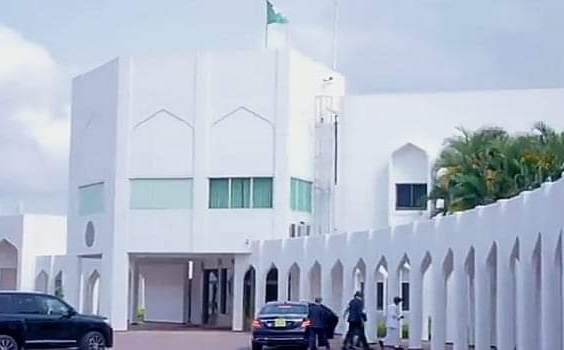
The alleged fake Presidential Foreign Investment Promotion Council (PFIPC) may have found its way into the 2026 Federal Government budget through a stunning trail of questionable letters and a “phantom” office in the State House.
This was revealed yesterday as the House of Representatives panel investigating the controversial council concluded its public hearing.
The panel chairman, Yusuf Gagdi, said investigations uncovered how the purported agency allegedly obtained an administrative code using documents linked to a non-existent office in the State House.
The code, according to him, later became the key that opened the door for the alleged fake agency to secure a budget line in the 2026 Appropriation Act.
Gagdi said neither the Office of the Director of Administration and Support Services nor an official identified as Akanbi Adewale exists in the State House.
He therefore warned witnesses against dragging the State House into the scandal.
“You people should not mention the State House in this matter,” the chairman warned.
According to Gagdi, the investigation showed that forged documents were allegedly used to manipulate administrative procedures across government institutions.
He said the findings had also dispelled claims that the State House or the National Assembly inserted the purported agency into the national budget.
The explosive revelation followed testimony from Joshua Luka, a former Director of Consolidated Accounts at the Office of the Accountant-General of the Federation (OAGF), who is now Director of the Federal Projects/Financial Management Department.
Luka told lawmakers that his office had received what appeared to be a legitimate request from the State House for an administrative code for the council.
The request was signed “for Permanent Secretary” by Akanbi Adewale, who identified himself as Director of Administration and Support Services.
But in what later became a major twist in the investigation, Luka said his office did not send the administrative code directly to the purported agency.
Instead, it was addressed to the Permanent Secretary, State House, as part of a safeguard designed to expose any fraudulent request.
“As part of our due diligence, what we did was to convey the administrative code to the Permanent Secretary, State House, and not to the so-called agency,” Luka told the panel.

He said the fraud should have been exposed immediately if the letter had reached the Permanent Secretary.
“The idea behind this was that if it was not from there, the whole thing would have been unravelled. That is the normal thing done in the service,” he added.
But then came the bombshell.
Lawmakers wanted to know how a letter meant for the Permanent Secretary, State House, ended up in the hands of Prince Adeniyi Adeyemi Mathew, the self-styled Director-General of the purported council.
Luka insisted that the letter was never meant for the alleged agency.
“The letter was addressed to the Permanent Secretary, State House, and it was supposed to be delivered there,” he said.
He told the panel that Adeyemi allegedly went to the Accountant-General’s Office and personally collected the correspondence.
The Budget Office, Luka explained, had only received an advance copy for information and could not act on it unless the original addressee initiated the process.
Luka said he signed the correspondence on December 2, 2024, but travelled to Tanzania shortly afterwards with the Accountant-General and therefore did not supervise its delivery.
He described the incident as a case of an official letter being diverted from its intended destination.
“The problem was the person who was supposed to deliver this letter, carrying a letter that was addressed to the Permanent Secretary, State House, and delivering it probably in Wuse Market,” he said.»
When lawmakers pressed him on who handled the delivery, Luka identified an official of the Accountant-General’s Office, Mr Bello.
Bello subsequently told the panel that government agencies normally collect official correspondence themselves.
He confirmed that Adeyemi personally visited the Accountant-General’s Office and collected the letter purportedly on behalf of the State House.
For Gagdi, that was another major breakthrough.
He said the administrative code obtained through the controversial correspondence became the foundation for the alleged fake agency’s eventual appearance in the Federal Government budget.
The chairman further alleged that Adeyemi subsequently forged another document purportedly issued by the non-existent Department of Administration and Support Services in the State House.
The alleged forged document, Gagdi said, acknowledged receipt of the administrative code and was then forwarded to the Budget Office.
That, according to him, ultimately misled officials into processing budgetary provisions for the purported council and paved the way for its inclusion in the 2026 Appropriation Act.
But Luka rejected suggestions that the incident exposed a systemic failure at the OAGF.
He said the problem was caused by an individual who allegedly hijacked the official correspondence.
“What I’m saying is that the lapse here was not an office lapse. The letter was hijacked. It was an individual’s fault and not a system fault,” he said.»
Luka maintained that the alleged fraud would have been uncovered much earlier if the original letter had reached the Permanent Secretary, State House, as it was intended to.