
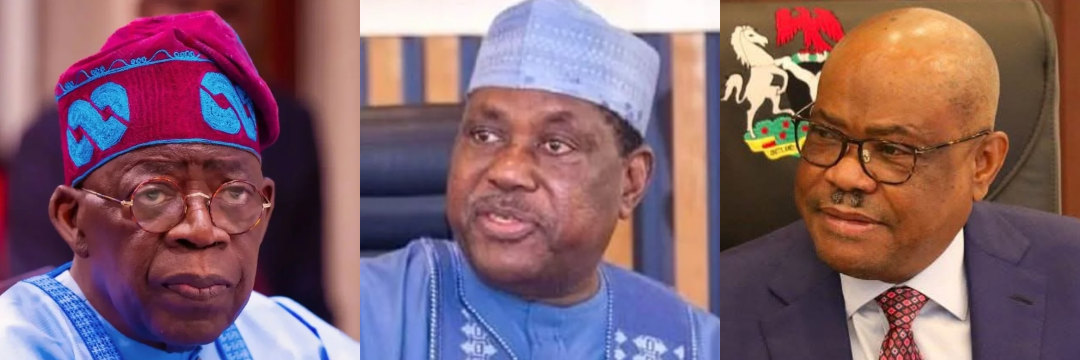
President Bola Tinubu, Secretary to the Government of the Federation, George Akume, FCT Minister Nyesom Wike and several other top government officials were allegedly listed as members of the governing board of the controversial Presidential Foreign Intervention Promotion Council (PFIPC), sparking fresh questions in the House of Representatives.
The shocking revelation came as the House ad hoc committee investigating the PFIPC grilled the Corps Marshal of the Federal Road Safety Corps (FRSC), Shehu Mohammed, over the issuance of seven official vehicle number plates to the organisation.
The lawmakers questioned why the FRSC approved the plates despite what they described as apparent red flags in documents submitted by the organisation.
Committee chairman, Yusuf Gagdi, said documents presented to the FRSC purportedly listed Tinubu, Akume, Wike, the Head of the Civil Service of the Federation, the Governor of the Central Bank of Nigeria, the Attorney-General of the Federation and several ministers as members of the PFIPC governing board.
Those allegedly listed also included the ministers of finance, aviation, agriculture and food security, interior, budget and national planning, marine and blue economy, police affairs, transport, works and power.
Gagdi said the alleged composition of the board should have immediately raised questions within the FRSC, particularly because it purportedly included the President and several members of his cabinet.
He also questioned why the agency accepted a purported mandate from the organisation despite allegations that the document lacked official government security features.
“We are trying to expose the leakages so that agencies can close these gaps going forward. It is not to indict anybody,” Gagdi said.
The committee chairman said the unusual list of alleged board members and the nature of the documents presented should have prompted the FRSC to independently verify the PFIPC’s status with the Presidency and other relevant government institutions.
But Mohammed defended the FRSC, insisting that the agency followed its standard operating procedures before approving the number plates.
According to him, the FRSC received the PFIPC’s application on April 4, 2025, followed by a reminder dated April 11. Both documents were signed by Prince Adeyemi Adeniyi.
Mohammed said the application contained documents purporting to establish the council, its mandate and governing structure, as well as information about the vehicles for which official number plates were requested.
He said the FRSC also checked the organisation’s website, which operated on a federal government domain, and visited its office at the Federal Secretariat Complex in Abuja.
The Corps Marshal said the website and physical office gave the impression that the PFIPC was a legitimate federal government organisation.
He added that officials also verified the chassis numbers of the vehicles before the plates were issued.

However, Mohammed said the agency was later surprised to discover that the PFIPC was not an authorised federal government agency.
Following the discovery, he said the FRSC began retrieving all official number plates issued to the organisation and tightened its verification procedures to prevent a recurrence.
The controversy follows an investigation by the Independent Corrupt Practices and Other Related Offences Commission (ICPC), which recommended the prosecution of Adeniyi, the man accused of operating the PFIPC.
Adeniyi had claimed that Femi Gbajabiamila, Chief of Staff to President Tinubu and former Speaker of the House of Representatives, issued his appointment letter.
Gbajabiamila denied the allegation.
The ICPC, however, cleared the Presidency and the Central Bank of Nigeria of wrongdoing while identifying institutional lapses across several ministries, departments and agencies.
Among those cited were the Office of the Secretary to the Government of the Federation, Office of the Head of the Civil Service of the Federation, Office of the Accountant-General of the Federation, Budget Office and National Information Technology Development Agency.
The House committee is now probing how the alleged PFIPC structure was able to operate and secure official government-related recognition, including vehicle number plates, before its status was eventually questioned.
Don’t Miss Out! Join our WhatsApp Channel for instant news updates. Click here to join
ALSO READ:
FAKE AGENCY SCAM: 5 GOVT OFFICIALS IN POLICE NET
WHO SENT MONEY TO ATIKU? Former VP Raises Alarm Over ‘Suspicious’ Credit